Answer First
How to Play Spider Solitaire
Practice Board
Play Spider Solitaire While You Learn the Setup and Rules
Use the embedded browser game to test the setup, rules, and stock timing right away. Start with the beginner board, reveal hidden cards before reaching for the stock, and move into harder modes once the card movement rules feel natural.
The short answer: set up the card game with two standard decks, deal 10 tableau columns, turn only the top card of each column face up, build descending runs, and win Spider Solitaire by clearing eight same-suit King-to-Ace sequences. On your first move, try to reveal a hidden card while preserving same-suit mobility, then practice the rule on the playable board above. If you want to test a line, undo it, and compare the result, use the undo-button strategy guide.
Fast Answers
Quick Answers Before You Start Playing
Set up two decks in 10 columns, turn only the top card of each column face up, then use the playable board above to practice the move order.
How do I play Spider Solitaire?
Build descending runs, keep same-suit sequences movable, reveal hidden cards, use the stock late, and clear eight same-suit King-to-Ace runs.
Practice while readingWhat rules matter most during play?
Move by descending rank, move groups only when they are same-suit, fill empty columns with any card or movable run, and deal only when all columns are filled.
See rules answerWhat is the basic order of play?
Check the setup, make a reveal-first move, preserve same-suit mobility, delay the stock, then choose 1 suit, 2 suits, or 4 suits for practice.
Use the instruction mapInstructions Map
Spider Solitaire Instructions From Setup to Win
Use this board map when you need Spider Solitaire instructions. It connects the physical card setup with the playable board above: the tableau is where you move and reveal cards, the stock is the 50-card reserve, and completed same-suit runs leave the tableau as foundation piles.
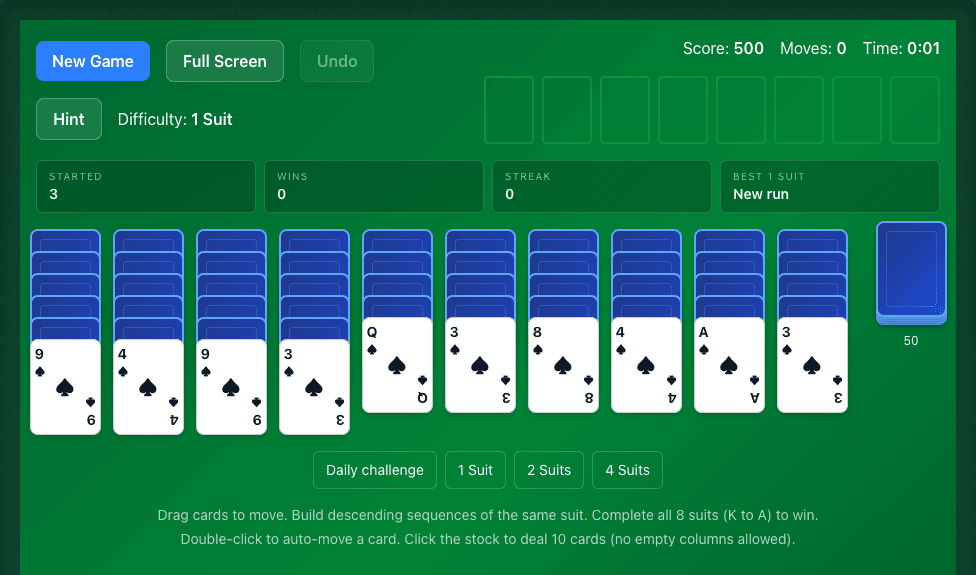
| Part | Instruction | What to check on the board | Next page |
|---|---|---|---|
| Setup | Use two decks, deal 10 columns, and leave 50 cards in the stock. | The first 4 columns are taller than the last 6 columns. | Setup guide |
| Tableau | Move a face-up card onto a card exactly one rank higher. | A 7 can move onto an 8; a Queen can move onto a King. | Rules reference |
| Movable run | Move a descending group together only when every card is the same suit. | Mixed suits can stack, but the mixed section is locked until separated. | Mixed-suit examples |
| Empty column | Use empty columns as temporary workspace for reveals and rebuilds. | Do not fill an empty space unless it helps reveal, sort, or delay stock. | Empty-column guide |
| Stock | Deal one card to every column only after all 10 columns are filled. | The stock is a reset pressure tool, not the first move. | Stock rules |
| Foundation | Clear a same-suit King-to-Ace run; repeat until all eight runs are gone. | A completed run leaves the tableau automatically in this browser game. | Win guide |
Mode tip: starting in 1 suit is more forgiving because almost every opening move preserves same-suit mobility, while 4-suit starts offer fewer same-suit opening moves even when the total legal move count looks similar.
Continue with the step-by-step tutorial when you want a guided practice board.
Direct Answer
How to Set Up Spider Solitaire
Spider Solitaire uses two standard decks and starts with 104 cards. Deal 10 tableau columns, give the first 4 columns 6 cards each, the remaining 6 columns 5 cards each, and flip only the top card of each column face up. The other 50 cards stay in the stock.
| Part | Standard setup | Why it matters |
|---|---|---|
| Decks | 2 standard 52-card decks, jokers removed | Gives you 104 cards and 8 complete King-to-Ace runs to build. |
| Tableau | 10 columns, with 54 cards dealt to the board | Creates the face-down structure you uncover as you play. |
| Face-up cards | Only the top card in each column starts face up | You need moves that reveal hidden cards and unlock mobility. |
| Stock | 50 cards left after the tableau deal | Each stock click adds one card to each tableau column. |
Visual Setup Map
| Columns 1-4 | Columns 5-10 | Stock |
|---|---|---|
| 6 cards each, top card face up | 5 cards each, top card face up | 50 undealt cards waiting for five stock rows |
Shortcut for physical cards: count out 54 tableau cards first, then stop. The rest of the deck becomes the stock pile.
Setup Checks Before You Start
- 10 columns are visible on the tableau.
- The first 4 columns have one extra hidden card.
- Only the top card of every column is face up.
- The stock still holds 50 cards for later deals.
Need the card-by-card layout? Open the How to Set Up Spider Solitaire. For stock timing, read the stock rules page. When you are ready to practice on a larger desktop board, open full-screen Spider Solitaire. For a repeatable 2-suit board, try Daily Spider Solitaire.
Spider Solitaire Rules
The Rules You Need to Play the Card Game
Use this as the decision order while you play: reveal hidden cards first, keep same-suit runs movable when possible, use empty columns as workspace, and delay the stock until the board has no better tableau move. For a deeper decision model, read the empty column strategy article.
Place a card on another card that is exactly one rank higher.
Only same-suit descending sequences can move together as a group.
You can stack mixed suits in descending order, but mixed-suit runs cannot move as one unit.
Any single card or legal same-suit sequence can fill an empty tableau column.
Deal from the stock only after every tableau column contains at least one card.
Use those five rules in that order while you practice on the board above. For narrower decisions, jump to the Spider Solitaire Rules, mixed-suit examples, or the scoring guide. For a fuller priority order, use the Spider Solitaire strategy guide.
First Moves
What To Do on Your First Turns
The beginner trap is not a lack of legal moves. It is using a legal move that kills same-suit mobility too early. Use this order before you click the stock.
| Priority | Why it matters | Best for | Next guide |
|---|---|---|---|
| Reveal a hidden card before anything else | New face-up cards create more legal choices than a cosmetic rank cleanup. | Beginner boards and early 2-suit games | Win guide |
| Prefer same-suit links over mixed-suit links | Same-suit sequences keep moving later instead of freezing into one heavy stack. | Every mode, especially 2 suits and 4 suits | Mixed-suit guide |
| Save empty columns for your next reveal plan | An empty column is workspace, not just a parking spot for the first legal card. | Mid-board traffic jams and stock-delay decisions | Empty-column strategy |
| Delay the stock until the tableau is truly stuck | The stock adds a card to every column and can bury the run you were about to free. | Any board before the first stock deal | Stock rules |
Stock Rule
When Should You Deal From the Stock?
Deal only after you have used the available tableau moves. Every stock deal adds a face-up card to each column, so early deals can bury useful runs and make the board harder to untangle. For more examples, read the stockpile mistakes guide.
Game Objective
How Do You Win Spider Solitaire?
You win by clearing eight complete King-to-Ace sequences of the same suit. Each completed run leaves the tableau automatically, which is why same-suit mobility matters so much from the start.
Read the win-condition guideFast Path
If You Are New, Follow This Order
- 01Open 1-suit Spider and make descending moves that keep cards in the same suit.
- 02Reveal face-down cards before dealing from the stock whenever the tableau still has useful moves.
- 03Use empty columns as workspace instead of filling them immediately with a low-value move.
- 04Move to 2 suits only after same-suit sequences and stock timing feel natural.
Playable Next Step
Pick the Right Board After You Learn the Rules
1 Suit
Best first board because nearly every opening move preserves the suit rule you are trying to learn.
Play 1-suit now2 Suits
Move here when you can already protect same-suit runs and want decisions that feel closer to full Spider.
Practice 2 suitsSetup Guide
See the exact two-deck layout, column counts, and stock pile breakdown.
Card Count
Confirm the 104-card layout, 54-card tableau, and 50-card stock pile.
Spider Solitaire Rules
Review legal moves, same-suit movement, empty columns, and the win condition.
Difficulty Modes
Compare 1-suit, 2-suit, and 4-suit Spider before choosing a board.
Tutorial
Practice a seeded beginner board with a step-by-step 1-suit lesson.
Stock Rules
Learn when to deal and why the stock can punish early clicks.
Mixed-Suit Moves
Understand why mixed suits stack fine but rarely move well as a group.
No-Download Play
Open the free online game instantly in your browser.
FAQ
How do you set up Spider Solitaire?
Use two standard decks, deal 10 tableau columns, give the first 4 columns 6 cards and the remaining 6 columns 5 cards, turn only the top card face up, and keep the remaining 50 cards in the stock.
How do you set up Spider Solitaire with cards?
With cards, the setup is the same: two decks, 10 columns, 54 cards in the tableau, and 50 cards in the stock. Only the top card in each column starts face up.
What are the Spider Solitaire rules?
You build descending runs, same-suit sequences can move together, mixed suits can stack but not move as a group, empty columns can accept any legal card or same-suit sequence, and the stock deals one card to each column only when every column is filled.
What are the basic Spider Solitaire instructions?
Set up two decks into 10 tableau columns, move cards in descending rank order, keep same-suit sequences together when possible, reveal hidden cards, deal the 50-card stock only when every column is filled, and clear eight same-suit King-to-Ace runs.
How do you play the card game Spider Solitaire?
Play Spider Solitaire by moving face-up cards onto cards one rank higher, preserving same-suit runs so they can move as a group, using empty columns as workspace, and building complete King-to-Ace sequences that clear from the tableau.
What is Spider Solitaire set up?
Spider Solitaire set up means dealing 10 tableau columns from two decks, with 6 cards in the first 4 columns and 5 cards in the other 6 columns, then leaving 50 cards in the stock pile.
Can you move mixed suits in Spider Solitaire?
You can stack mixed suits in descending order, but you cannot move a mixed-suit sequence as one group. Only same-suit descending sequences move together.
Is Spider Solitaire a card game?
Yes. Spider Solitaire is a card game played with two standard decks, a 10-column tableau, and a stock pile.
When should you deal from the stock?
Deal from the stock after you have used the available tableau moves, because each deal adds one card to every column and can bury useful runs.
How do you win Spider Solitaire?
You win by clearing eight complete King-to-Ace sequences of the same suit.
Which Spider Solitaire difficulty should beginners choose?
Beginners should choose 1-suit Spider Solitaire because all descending moves preserve suit mobility. In the site's June 2026 opening-deal simulation, 1-suit starts had a same-suit opening move 99.34% of the time, compared with 82.34% for 4-suit starts.
What should I learn first in Spider Solitaire?
Learn the setup, then focus on same-suit moves, hidden-card reveals, empty columns, and stock timing. Same-suit mobility is the first major difficulty split between 1-suit, 2-suit, and 4-suit Spider.
Why does this page answer setup and rules before strategy?
Setup and move rules are the first blocker before strategy can help. Once the board layout and legal moves feel natural, use the linked practice game to learn stock timing, empty columns, and same-suit mobility.